The $34 Broth Heard 'Round the World: One Foodie's Crisis of Faith After Meeting Chad
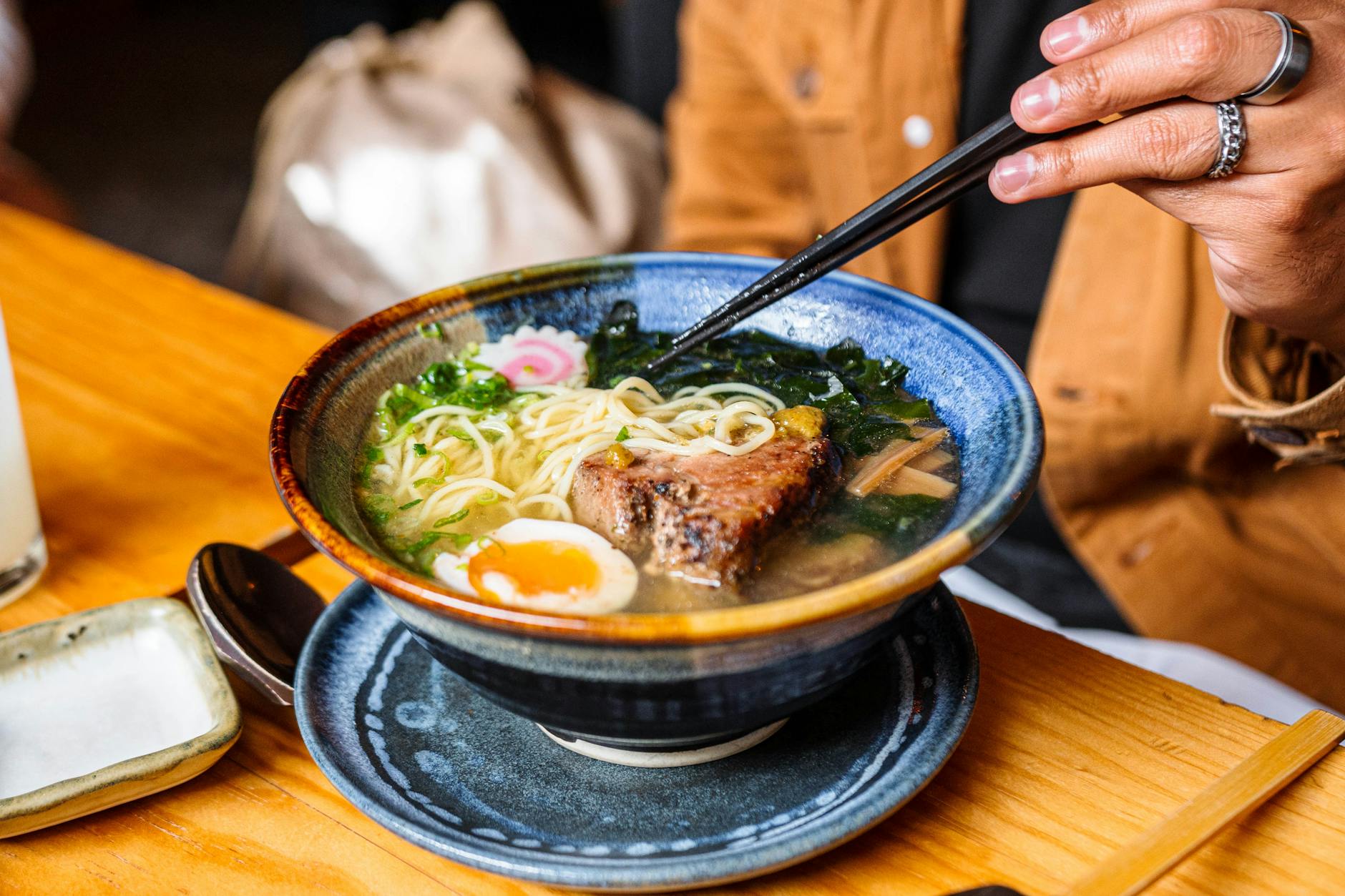
The $34 Broth Heard 'Round the World: One Foodie's Crisis of Faith After Meeting Chad
By Breckin Oatsworth | The Food Woke Report
There is a specific kind of grief that no therapist has yet been adequately trained to address. It is not the grief of loss, exactly. It is the grief of realization — the slow, nauseating dawning that the $34 bowl of ramen you have been describing to coworkers as "genuinely transcendent" was prepared by a man named Chad who, three weeks ago, asked to borrow your leaf blower.
Marcus Tillerman, 34, of Portland, Oregon, is currently living inside that grief. And frankly, he looks terrible.
The Sacred Ritual of the Minimalist Restaurant
For the uninitiated, allow us to paint the scene. Umami no Kokoro — which translates roughly to "Soul of Umami" and also, less poetically, to "$14 for a side of soft-boiled egg" — opened eighteen months ago in Portland's increasingly unhinged Pearl District. The restaurant seats exactly eleven people. There are no menus, only a QR code that links to a six-paragraph PDF about the chef's "philosophical relationship with dashi." The walls are raw concrete. A single dried flower hangs from the ceiling. The music is described on their website as "meditative field recordings from the Hokkaido coastline" but is, upon closer inspection, a YouTube video of waves with 4.2 million views.
Marcus had eaten there four times. He had posted about it twice. He had, on one occasion, described the broth as having "a finish like a memory you haven't had yet."
He typed that. With his fingers. And sent it into the world.
Enter Chad
The unraveling began at a neighborhood block party — that most democratic and therefore most dangerous of social institutions. Marcus was standing near the potato salad when he spotted the chef from Umami no Kokoro across the folding table, wearing a Patagonia vest and eating a hot dog with both hands.
"I recognized the headband first," Marcus told us, his voice barely above a whisper. "He always wears this specific black headband in the restaurant. Very austere. Very intentional. Turns out he just sweats a lot."
The chef's name, as his wife helpfully announced while calling him over for a photo, was Chad. Chad Brentley. He lives four houses down. He drove a Kia Sorento. He had, Marcus would later learn, attended the University of Oregon on a partial lacrosse scholarship and discovered ramen during a "pretty wild semester" studying abroad in Tokyo, which he describes as "basically the best four months of my life, honestly."
Chad is not, to be clear, a third-generation noodle artisan. Chad is a guy who got really into ramen, took an online course, watched approximately 340 hours of YouTube, and — here is the part that stings — is genuinely quite talented at it.
The Price of Ambiance, Itemized
This is the part where The Food Woke Report must perform a small public service, because the math here is illuminating in ways that should probably be taught in schools.
We did some investigative journalism, which is to say we asked Chad directly, at the block party, while he was on his second hot dog. Here is a rough breakdown of what comprises a $34 bowl of ramen at Umami no Kokoro:
- Actual ingredients: Approximately $4.80, by Chad's own estimate
- Chad's labor: Reasonable, he works hard, fine
- The concrete walls: You are paying for the concrete walls
- The dried flower: You are paying for the dried flower
- The vibe of scarcity (eleven seats): You are paying for the vibe of scarcity
- The fact that the reservation system requires a credit card hold and a 48-hour cancellation window: You are paying for the anxiety
- The PDF about dashi philosophy: Complimentary, technically, but spiritually very expensive
For comparison, a Cup Noodles Spicy Chicken retails for approximately $1.09 and contains, according to our research, a similar volume of noodles, sodium, and human longing.
Authenticity: A Love Story With No Happy Ending
The foodie industrial complex runs entirely on the fuel of authenticity — a concept so slippery, so endlessly redefinable, that it has become essentially meaningless while somehow becoming more valuable than ever. Authenticity now costs a $34 cover charge, requires a specific ZIP code, and is best experienced in a room where no one is allowed to laugh too loudly.
Marcus understood this, intellectually. What he could not process emotionally was that Chad — regular Chad, neighbor Chad, leaf-blower-borrowing Chad — had successfully manufactured that authenticity from scratch using nothing but good technique, a headband, and the strategic deployment of an eleven-seat dining room.
"I'm not even mad that it's delicious," Marcus said, staring into the middle distance near the block party's inflatable bounce castle. "It is delicious. That's almost the worst part. If it were bad, I'd have somewhere to put this feeling."
He paused.
"I told my boss it changed my relationship with impermanence."
Chad, For His Part, Is Doing Great
We caught up with Chad the following Tuesday. He was, by all appearances, untroubled. He offered us a beer. He showed us his ramen setup, which is genuinely impressive and also located in a kitchen that has a Little League schedule on the refrigerator.
"I mean, people love it," Chad said, with the easy confidence of a man who has never once described food as having "a finish like a memory you haven't had yet." "I make really good ramen. The restaurant looks cool. People feel like it's special. Is that bad?"
Reader, it is not bad. That is, objectively, the entire point of restaurants. We know this. You know this. Marcus, somewhere in his soul, knows this too — he just needs a few more weeks and possibly a licensed therapist to get there.
The Lesson, If There Is One
There is a version of this story where Marcus emerges enlightened — freed from the tyranny of prestige dining, liberated to enjoy a $1.09 Cup Noodles with the same spiritual openness he once reserved for concrete-walled establishments with dried flowers and coastal field recordings.
We checked in with him last week. He had made a reservation at a new omakase place in the Alberta Arts District. Eighteen seats. No menu. The chef, according to the website, "trained under silence in the mountains of Nagano."
The chef's name, we have since confirmed through minimal research, is probably Derek.
Marcus is going to be fine.
Breckin Oatsworth is a staff writer at The Food Woke Report. He once paid $22 for toast and has never fully recovered.