The Crime: Asking for Coffee at a Coffee Shop
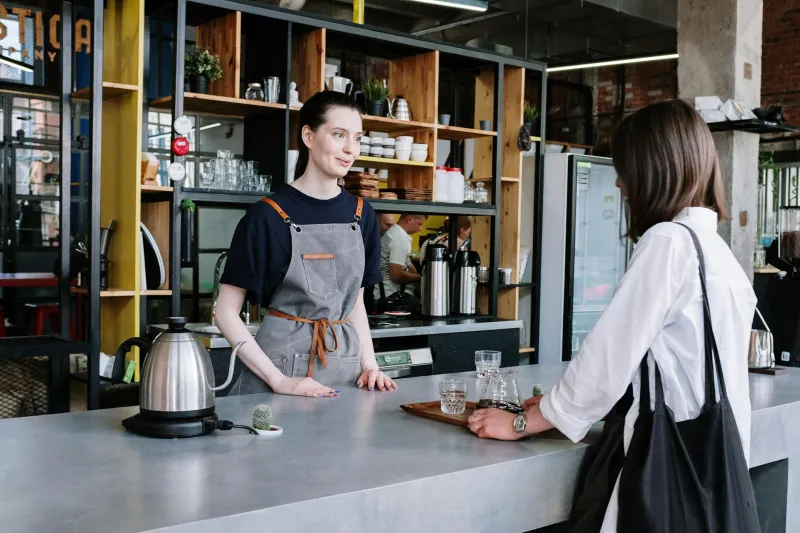
It was 8:47 AM on a Tuesday when Margaret Chen committed what would later be classified as a Category 5 café faux pas. Standing in line at Ethereal Grounds—a converted warehouse space where coffee costs more per ounce than premium gasoline—she approached the counter with the naive confidence of someone who simply wanted caffeine.
"I'll take a regular coffee, please," she said.
The silence that followed could have powered a small wind farm.
"Regular," repeated the barista, whose name tag read "Sage" and whose soul clearly died a little. "Like... drip?"
Margaret, unaware she had just triggered what coffee industry insiders call "The Shame Spiral," nodded enthusiastically. "Yes! Just... coffee."
The Hierarchy of Acceptable Orders
According to leaked internal documents from the International Brotherhood of Artisanal Coffee Gatekeepers (IBACG), there exists a complex social stratification system governing acceptable café orders. Our investigation uncovered a 23-page flowchart that baristas across major metropolitan areas use to determine appropriate levels of customer judgment.
Tier 1 (Acceptable): "I'll have the single-origin Ethiopian Yirgacheffe, washed process, brewed at 205 degrees with a 1:16 ratio, please."
Tier 2 (Tolerable): "Could I get a pour-over? I trust your recommendation."
Tier 3 (Concerning): "I'll take a latte."
Tier 4 (Red Flag): "Do you have regular coffee?"
Tier 5 (Code Black): "I'll take a medium coffee, cream and sugar."
"When someone orders 'regular coffee,' we have protocols," explains Marcus Windham, a former barista at Conscious Cup Collective who spoke on condition of anonymity. "First, we make eye contact with our colleagues to confirm the violation. Then we begin the re-education process."
The Re-Education Process
The re-education process, as documented in our investigation, involves a series of increasingly condescending questions designed to make customers aware of their coffee ignorance:
"What kind of flavor profile are you looking for today?"
"Are you interested in exploring our single-origins?"
"Have you considered how your beverage choice reflects your personal values?"
Dr. Amanda Rodriguez, a fictional sociologist at the Institute for Beverage-Based Social Dynamics, explains the psychology: "These establishments have created an environment where ordering coffee requires the same level of expertise as performing surgery. Customers who lack this knowledge are made to feel like they've shown up to a Michelin-starred restaurant asking for chicken nuggets."
The Support Group
In a cramped community center basement in Portland, twelve people sit in a circle sharing their stories. This is Caffeinated Trauma Recovery (CTR), a support group for individuals who've experienced coffee-ordering shame.
"My name is Dave, and I asked for a 'normal coffee' at Blue Bottle," shares a man in his forties, his voice barely above a whisper. "The barista asked me to define 'normal.' I said, 'You know, coffee-flavored coffee.' The entire café went silent. I haven't been the same since."
Group leader Patricia Hoffman, herself a survivor of a 2019 incident where she pronounced "macchiato" incorrectly at a café in Berkeley, nods knowingly. "The healing begins when we accept that we're not broken—the system is."
Geographic Variations in Coffee Judgment
Our investigation revealed that acceptable coffee orders vary dramatically by zip code. In Manhattan's SoHo district, ordering anything less complex than a cortado marks you as a tourist. In Seattle, asking about the roast date is considered basic courtesy. In Portland, requesting oat milk instead of the café's house-made walnut-cashew blend is grounds for social exile.
"I moved from Cleveland to San Francisco," explains Jennifer Walsh, a marketing executive who experienced severe coffee culture shock. "In Cleveland, coffee was coffee. In San Francisco, I learned that my beverage choice was apparently a reflection of my commitment to environmental justice and personal growth. I spent $400 on coffee education courses just to order breakfast."
The Williamsburg Incident
Perhaps no story better illustrates the severity of coffee shaming than the infamous Williamsburg Incident of 2023. Local resident Tony Marconi, age 34, entered Transcendent Beans & Beyond asking for "whatever's already made" during the morning rush.
Witnesses describe the scene as "devastating." The lead barista, identified only as "River," allegedly responded with a 12-minute lecture on the violence of industrial coffee production and its relationship to colonialism. Marconi was reportedly seen fleeing the establishment, later found at a nearby Dunkin' Donuts, quietly weeping into a large regular coffee.
"I just wanted to be awake for my meeting," Marconi told our reporter. "I didn't realize I was participating in global oppression."
The Path Forward
As coffee culture continues to evolve into increasingly esoteric territory—with some establishments now requiring customers to meditate with their beans before ordering—advocates like CTR are pushing for reform.
"Coffee shops should serve coffee," argues Hoffman. "Revolutionary concept, I know."
The IBACG did not respond to our requests for comment, though sources suggest they're developing new protocols for customers who use terms like "joe," "brew," or the particularly offensive "cup of coffee."
Meanwhile, Margaret Chen has found her own solution. She now exclusively frequents a gas station near her office, where the coffee costs $1.50 and nobody asks about her relationship with caffeine.
"Best coffee I've ever had," she says, taking a satisfied sip from her styrofoam cup. "It tastes like freedom."