Eulogy for the Plain Sandwich: A Nation Mourns the Last Man Who Just Wanted Turkey on Wheat
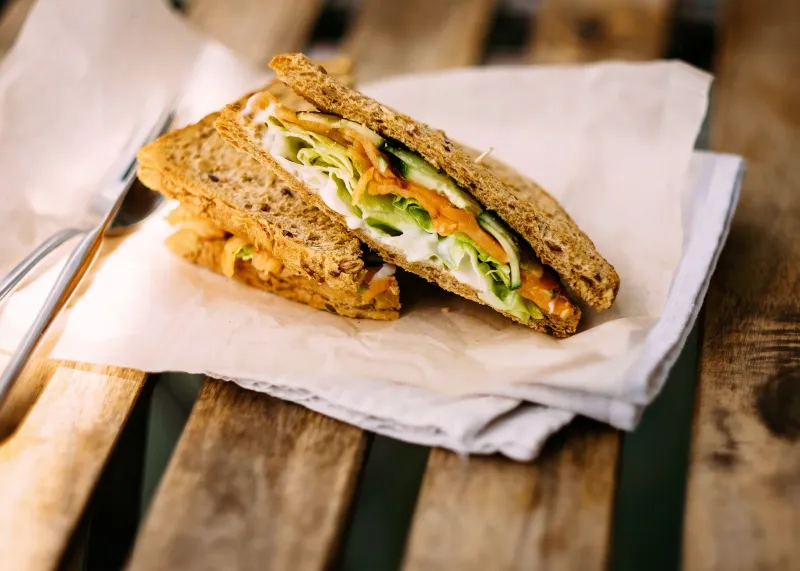
Gerald Fitch, 54, of Akron, Ohio, was found unresponsive Tuesday afternoon in the doorway of a sandwich establishment called CONSTRUCT, after spending an estimated twenty-three minutes attempting to locate a menu item that was, in any recognizable sense, a sandwich. He is survived by his wife, two adult children, and a very reasonable desire for lunch.
 Photo: Akron, Ohio, via www.habama.co.il
Authorities say Gerald had entered CONSTRUCT at approximately 12:17 PM, believing — based on the sign, the general shape of the building, and decades of accumulated cultural context — that he would emerge with something between two pieces of bread. He did not emerge at all. A hostess found him at 12:40 PM, seated on the floor near the host stand, quietly holding a laminated menu card that read Tension Studies in Compressed Bread Architecture and whispering the word "mustard" to no one.
He was, investigators confirmed, the last of his kind.
A Brief History of the Sandwich Before We Ruined It
For most of American history, a sandwich was a straightforward covenant between a human being and their lunch. Bread. A protein. A condiment of modest ambition. Perhaps a leaf of lettuce, if you were feeling festive. The transaction was completed in under ninety seconds and both parties — the sandwich and the person eating it — understood their roles implicitly.
Then, somewhere around 2014, something went wrong.
Food historians — a group that did not need to exist but now very much does — point to a convergence of factors: the rise of the chef-driven fast casual movement, the Instagram-ification of the lunch hour, and the arrival of a generation of culinary school graduates who had strong opinions about bread tension and had never been told, with sufficient firmness, to stop.
The sandwich did not die quickly. It was deconstructed, then reconstructed, then deconstructed again and called a "study." It was placed in quotes. It was given a backstory. It was described as "a conversation between the grain and the cure." It was served open-faced, then closed-faced, then served in a way where the face was not immediately identifiable. It was renamed. It became a "vessel." A "compression." A "protein moment."
And at no point — not once — did anyone in a position of authority stand up and say: Gerald just wants turkey on wheat.
The Menu That Finished Him
The CONSTRUCT menu, obtained by The Food Woke Report via a source who escaped the restaurant with their sanity and a to-go bag, is a remarkable document. Printed on what appears to be the same material used for upscale business cards, it is organized not by ingredient or price but by "structural philosophy."
Section one is titled Foundations. It contains no sandwiches. It contains three items described as "load-bearing grain expressions," each named after a mid-century architect.
Section two is Tension Studies, which is where Gerald's journey ended. The items in this section are described using language that would be more appropriate in a materials science journal than a lunch menu. One item — the closest thing to a BLT visible to the naked eye — is described as: A dialogue between cured pork belly, heirloom tomato compression, and a butter lettuce intervention, unified by a smoked aioli that asks more questions than it answers.
It costs $24. There is no dollar sign.
Section three is simply titled Aftermath, which, in retrospect, was a warning.
"He kept looking for the sandwiches," said a witness who was dining at CONSTRUCT at the time of the incident. "He flipped it over. He asked the server if there was a regular menu. The server said, and I'm quoting, 'This is the regular menu. Are you familiar with our philosophy?' And that was when Gerald sat down on the floor."
A Eulogy for the Plain Lunch Order, 1762–2024
Gerald was not the first casualty. He was simply the last.
The plain lunch order had been in declining health for years. It was first destabilized by the artisanal bread movement, which made it impossible to order "a roll" without being offered a choice between seven heritage grain varieties and a brief lecture on fermentation timelines. It was further weakened by the condiment renaissance, during which mustard became "whole grain Dijon with stone-milled intention" and mayonnaise became something you were expected to have feelings about.
It suffered its first major cardiac event when the word "curated" entered sandwich vocabulary. It never fully recovered from the arrival of microgreens as a structural element. And it was delivered its final blow the day a restaurant in Brooklyn served a grilled cheese with a QR code linking to the cheese's origin story and described the bread as "emotionally load-bearing."
Gerald simply happened to be standing in the wrong doorway when it finally gave out.
What We Lost When We Lost the Sandwich
This is not merely a story about one man and one menu. It is a story about a cultural inflection point at which the American lunch — historically one of our most democratic institutions, available to all, pretentious to none — was quietly taken away and replaced with something that requires orientation.
The plain sandwich asked nothing of you. It did not need you to understand its philosophy. It did not have a philosophy. It had turkey. It had bread. On a good day, it had a pickle, and the pickle did not have a backstory.
What replaced it asks everything. It asks for your attention, your vocabulary, your willingness to describe a condiment as "asking questions," and — perhaps most critically — your $24, delivered without a dollar sign so you don't experience the pain of paying.
Gerald experienced the pain of paying. He just wanted it to be for a sandwich.
In Lieu of Flowers
The Fitch family has asked that in lieu of flowers, mourners make a turkey sandwich at home. Plain bread. Deli turkey. Yellow mustard from the squeeze bottle. Eat it over the sink if you want to. Eat it without thinking about the grain's emotional journey or the mustard's philosophical position.
Eat it because it is lunch, and lunch does not owe you a manifesto.
Gerald would have wanted that.
CONSTRUCT released a statement expressing condolences and noting that their menu is available as a 47-page digital experience with optional audio guide. The audio guide is narrated by someone who describes themselves as a "sandwich dramatist." It costs $4.99.