Farmers Markets Unveil Itemized 'Virtue Receipt' So You Know Exactly What Your $9 Peach Paid For
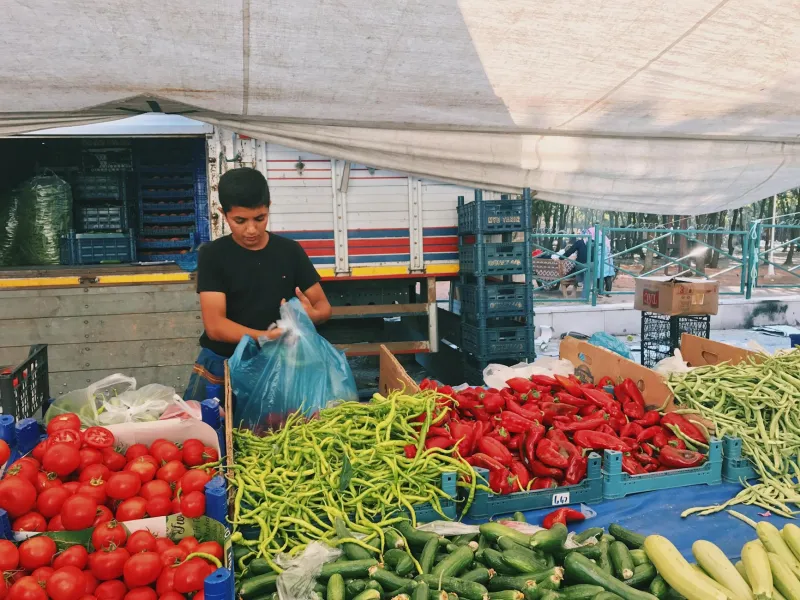
Farmers Markets Unveil Itemized 'Virtue Receipt' So You Know Exactly What Your $9 Peach Paid For
In what organizers are calling "a landmark moment for radical pricing transparency," a coalition of farmers markets across the United States announced this week the voluntary adoption of the Itemized Virtue Receipt — a new point-of-sale system that breaks down, line by line, exactly what consumers are purchasing when they hand over $9 for a single peach at 9 a.m. on a Saturday.
The initiative, which is completely fictional but feels plausible enough to be unsettling, was developed in response to what coalition spokesperson Fern Aldgate described as "a growing consumer desire to understand the full value proposition of the farmers market experience."
"People deserve to know what they're paying for," Aldgate said at a press event held, naturally, outdoors, near a chalkboard sign advertising "living lettuce." "And what they're paying for is so much more than produce."
She is correct. The receipt makes this explicit.
Breaking Down the $9 Peach
According to sample Virtue Receipts provided to The Food Woke Report, a standard $9 peach purchase at a participating market breaks down as follows:
Actual peach: $1.40 Premium for it being described as 'heirloom': $0.85 Moral superiority surcharge over Walmart shoppers: $1.20 Farmer's Instagram content creation time (allocated per unit): $0.65 Ambient fiddle music licensing fees: $0.30 Your tote bag's carbon offset (estimated): $0.45 The right to say 'I got this at the farmers market' for the next 10 days: $1.75 Chalkboard sign calligraphy amortization: $0.22 Heirloom variety name pronunciation coaching (optional, included free this week): $0.00 Existential validation of your lifestyle choices: $1.18 Subtotal: $8.00 Sustainable vibes surcharge: $1.00 Total: $9.00
Customers at a test market in Asheville, North Carolina, reportedly stood in silence for a long moment upon receiving their first Virtue Receipt, then nodded slowly, folded it, and placed it in their tote bags.
"Honestly," said one shopper, who asked to be identified only as Margaux, "I feel like this is the most transparent thing that's ever happened to me at a farmers market. Usually I just kind of… accept that the math doesn't work and move on."
The Tote Bag Economy
Industry analysts have long suspected that the farmers market experience functions less as a food procurement system and more as a recurring identity performance — a weekly ritual in which participants confirm, via heirloom vegetable purchase, that they are the kind of person who shops at farmers markets.
The tote bag is central to this performance. Not just any tote — the specific tote that says something like "LOCAL ROOTS" or features an artful watercolor of a radish and the name of a farm that closed in 2019. The tote is carried to the market, filled with produce, and then photographed on a wooden countertop later that afternoon. The photograph is captioned with something involving the word "bounty."
"The tote is load-bearing infrastructure for the whole system," says consumer behavior researcher Dr. Pell Hutchins, who is fictional but whose analysis is accurate. "It's a portable billboard for a set of values. The values are real. The peach is also real. But the $9 is mostly paying for the billboard."
The new Virtue Receipt does, in fact, include a line item for tote bag identity amortization on purchases over $30, currently set at $2.15 per transaction.
The Fiddle Problem
Of all the line items on the Virtue Receipt, none has generated more conversation than the ambient fiddle music licensing fee.
Most established farmers markets feature live acoustic music — typically a duo performing folk songs at a volume calibrated to suggest authenticity without interrupting conversation about whether the rainbow chard is worth it. The musicians are paid. The payment comes, in part, from the produce markup. This has always been true. The Virtue Receipt simply says so.
"People act surprised," said one market organizer in Portland, Oregon, who asked to remain anonymous because she has to see these customers every week. "Where did they think the fiddle guy was getting paid from? The vibes don't pay for themselves."
The fiddle guy, reached for comment, said he was just happy to be acknowledged.
Farmers, For Their Part, Are Tired
It would be easy — and this publication is not above easy — to treat the farmers market pricing conversation as purely about consumer vanity. But actual farmers, the humans who grow the food and drive it to the market at 4:30 a.m. and stand on their feet for six hours while people ask them to explain the difference between flat-leaf and curly parsley for the fourteenth time, occupy a more complicated position in this story.
Farming is expensive. Small-scale sustainable farming is very expensive. The premium prices at farmers markets often reflect genuine costs: labor, land, responsible growing practices, the absence of industrial-scale efficiencies. The $1.40 allocated to "actual peach" on the Virtue Receipt is a joke, but the underlying economics are not.
"I don't love the Instagram content creation line item," said one stone fruit farmer in the Hudson Valley, reviewing the sample receipt. "I do have an Instagram. I do spend time on it. But I'd prefer if people bought the peach because it tastes incredible, which it does, rather than because it makes them feel like a better person."
She paused.
"Though honestly, if the moral superiority surcharge keeps the lights on, I'm not going to fight it."
What Comes Next
The Virtue Receipt coalition says Phase 2 of the initiative will introduce expanded line items including a Seasonal Smugness Index (variable pricing based on how out-of-season the item is at competing grocery stores), a Heirloom Variety Obscurity Premium (higher charges for produce varieties no one has heard of), and a new optional add-on called The Locavore Legacy Fee — a $1.50 surcharge that funds a plaque at the market entrance listing the names of shoppers who have purchased there for five or more consecutive years.
The plaque will be made from reclaimed wood.
It will cost $340.
The cost will not be itemized.
The Food Woke Report fully supports farmers markets, small-scale agriculture, and the right of every American to spend $9 on a peach and feel great about it. We also support the fiddle guy. Please tip the fiddle guy.