The Promise: Radical Kitchen Sovereignty
I should have known something was wrong when the retreat confirmation email arrived in Comic Sans font with seventeen different shades of purple. But I was desperate. After months of meal kit subscriptions that left me feeling like a culinary failure and Instagram food influencers making me question whether I'd ever truly "nourished" myself, I was ready to pay $275 for someone to teach me how to meal prep with intention.
The "Mindful Meal Prep: Reclaiming Your Kitchen Sovereignty" retreat promised to "revolutionize your relationship with food preparation through trauma-informed batch cooking and ancestral meal wisdom." The website featured soft-focus photos of attractive people crying happy tears while holding root vegetables.
I packed my bags for what I assumed would be a weekend of efficient cooking techniques and maybe some organizational tips. I was so naive.
Day 1: Meeting My Vegetables
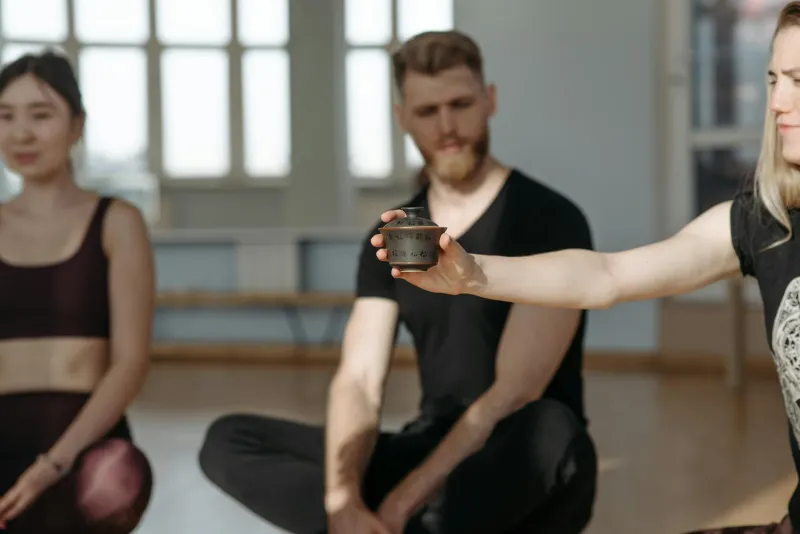
The retreat was held at a converted barn in Marin County, California, where the WiFi was "intentionally limited" and the bathroom was labeled "Sacred Elimination Space." Our group of twelve participants gathered in what the facilitator, Rainbow (birth name: Jennifer), called the "Intention Circle."
"Before we can prep meals," Rainbow announced, "we must first prep our hearts."
I glanced around at my fellow retreaters—a mix of anxious millennials and Gen X wellness seekers who all looked like they'd already spent significant money on therapy. We were handed journals with covers featuring watercolor vegetables and instructed to write a letter to our "inner chef."
"Dear Inner Chef," I wrote, feeling ridiculous, "I just want to make decent lunches for the week without crying."
Rainbow read my letter aloud to the group without permission, then asked everyone to share their feelings about my "resistance to vulnerability." I spent the next forty minutes explaining why I found the exercise silly, while Rainbow nodded sympathetically and made notes on a clipboard.
The Sweet Potato Incident
After lunch (deconstructed salad that cost more than my monthly Netflix subscription), we moved into what Rainbow called "Vegetable Relationship Building." Each participant was given a single sweet potato and instructed to "commune" with it for three hours.
"Hold your sweet potato," Rainbow guided us through the meditation. "Feel its weight. Its texture. What is it trying to tell you about your childhood?"
I sat cross-legged on a yoga mat, holding my sweet potato like it was a newborn baby, trying to extract deep meaning from a root vegetable that probably cost 89 cents at Safeway. Around me, other participants were having what appeared to be profound emotional breakthroughs with their tubers.
"My sweet potato is showing me my abandonment issues," sobbed Janet, a software engineer from San Jose. "I never let myself be as grounded as this beautiful earth apple."
My sweet potato was showing me nothing except that I had apparently paid nearly $300 to hold produce in a barn while people cried about root vegetables.
The Aluminum Foil Trauma Circle
Day two began with what Rainbow called "Kitchen Tool Shadow Work." We sat in a circle surrounded by common cooking implements while Rainbow guided us through our "relationship patterns" with kitchen equipment.
"Let's start with aluminum foil," she said, holding up a roll like it was a sacred artifact. "Who wants to share their foil story?"
Mark, a marketing executive from Portland, raised his hand tentatively. "I... I think I use too much foil. Like, way too much. I wrap everything. Even things that don't need wrapping."
The group nodded knowingly.
"Tell us about the first time you felt abandoned by food storage," Rainbow prompted.
For the next two hours, I listened to grown adults analyze their relationships with kitchen tools. Someone had "trust issues" with tupperware lids. Another participant couldn't use wooden spoons because they reminded her of her grandmother's "emotional unavailability."
When it was my turn, I said I had a good relationship with aluminum foil because it keeps food fresh and is recyclable. Rainbow looked concerned and asked if I was "bypassing my deeper truth."
The Meal Prep That Wasn't
By Saturday afternoon, I was expecting to finally learn some actual meal preparation techniques. Instead, Rainbow announced it was time for "Intuitive Batch Cooking."
"We're going to prepare a week's worth of meals using only our intuition and whatever the universe provides," she explained, gesturing to a table covered with random ingredients that looked like the contents of a health food store's clearance bin.
There were no recipes, no instructions, no measurements. We were supposed to "let our ancestors guide us" through the cooking process. I watched in horror as participants began combining ingredients based on "what felt right energetically."
One woman mixed quinoa with coconut oil and spirulina because "her inner goddess demanded green." Another man created what he called "trauma-healing soup" by combining bone broth with adaptogenic mushrooms and "whatever vegetables spoke to him."
I attempted to make a simple stir-fry and was immediately corrected by Rainbow, who informed me that my "aggressive" chopping technique indicated unresolved anger. She made me practice "compassionate vegetable preparation" by dicing carrots while repeating affirmations about self-love.
The resulting meal looked like it had been prepared by someone having a psychotic break in a Whole Foods. Everything was either underseasoned or overseasoned, overcooked or raw, and combined in ways that defied both logic and taste buds.
The Breaking Point
Sunday morning arrived with a "Gratitude Breakfast" consisting of chia pudding that tasted like wet cement and herbal tea that smelled like a lawn mower bag. Rainbow announced our final exercise: creating a "meal prep manifesto" that we would read aloud to the group.
"I will honor the sacred act of food preparation," read Jennifer, a yoga instructor from Berkeley. "I will not use my microwave as an act of violence against my nourishment."
When my turn came, I stood up and looked at the group of earnest faces surrounding me. "I just wanted to learn how to make decent lunches," I said. "Instead, I spent three days holding vegetables and talking about my feelings. This is insane."
The silence that followed could have powered a small wind farm.
Rainbow approached me with what I can only describe as aggressive compassion. "I hear that you're struggling with the vulnerability this process requires," she said. "Would you like to share what's coming up for you around resistance to growth?"
That's when I snapped.
"What's coming up for me," I said, "is that I paid $275 to hold a sweet potato and listen to people have breakdowns about tupperware. I came here to learn meal prep, not to explore my relationship with aluminum foil. This isn't wellness—it's performance art masquerading as self-help."
The Escape
I packed my bags during the "Closing Integration Circle" and drove straight to the nearest McDonald's. Sitting in my car in the parking lot, eating a Quarter Pounder with cheese, I felt more nourished than I had all weekend.
The burger was processed, probably full of preservatives, and definitely not aligned with any wellness philosophy. It was also delicious, satisfying, and exactly what I wanted. No meditation required.
I spent the drive home thinking about the weekend's events. Had I really paid nearly $300 to be told that my cooking methods were emotionally violent? Had I seriously listened to a group therapy session about kitchen utensils? Was there a world in which holding a sweet potato for three hours constituted meal preparation education?
The Real Lesson
The retreat taught me something valuable, though probably not what Rainbow intended. The wellness industry has taken something as basic as cooking—a survival skill humans have practiced for thousands of years—and transformed it into a $275 therapy session.
Somewhere along the way, we decided that making lunch required spiritual awakening. That meal prep needed to involve trauma processing. That you couldn't dice an onion without first examining your relationship with sharp objects.
The truth is, cooking is just cooking. Sometimes you make good food, sometimes you don't. Sometimes you use too much aluminum foil, and that's okay. Sometimes you microwave leftovers because you're tired and hungry, and that doesn't make you spiritually deficient.
I've since learned to meal prep the old-fashioned way: by looking up recipes online, buying ingredients, and cooking them without analyzing my emotional relationship with each vegetable. It works surprisingly well.
The sweet potato I was supposed to "commune" with? I roasted it with some olive oil and salt. It was delicious. No therapy required.
Epilogue: The Follow-Up Email
Two weeks after the retreat, I received an email from Rainbow asking how I was "integrating the experience" and offering a $200 "Kitchen Shadow Work" intensive to help me "process my resistance to growth."
I deleted it and made a sandwich.
Best $275 lesson I ever learned: sometimes the most mindful thing you can do is admit that the emperor has no clothes—even when the emperor is wearing a hemp apron and calling herself a meal prep guru.