Confessions from the Tupperware Tower: Twelve Months Inside the Meal Prep Cult and the Slow Unraveling That Happened Between the Quinoa and the Crying
The following accounts were gathered from participants in what researchers are now calling the Sunday Sacrifice Phenomenon — a voluntary, algorithmically-encouraged ritual in which otherwise functional American adults surrender their entire weekend to the preparation of identical meals they will spend the following week eating with diminishing enthusiasm. Names have been changed. The quinoa has not.
Week One: The Conversion
It begins, always, with a video.
The video is approximately 47 seconds long. It features a person — luminous, organized, wearing athleisure that costs more than your car insurance — standing in a kitchen that has never experienced a grease splatter. The counter is clean. The light is golden. There are exactly twelve identical glass containers arranged in a formation that suggests both military discipline and interior design competence. The person gestures at the containers with the calm authority of someone who has achieved something.
'Sunday meal prep,' they say, 'changed my life.'
The video has 2.3 million views. The comments are a cathedral of aspiration. Goals. This is exactly what I needed. Okay starting this SUNDAY. You double-tap. You screenshot. You text it to yourself with the note 'DO THIS.' This is the moment of infection. Everything that follows is a symptom.
Kristin, 31, a project manager from Columbus, Ohio, remembers her conversion with the precision of someone describing a car accident. 'It was a Tuesday night. I'd eaten cereal for dinner again. I watched the video and I thought: this is it. This is the version of me that has it together. I bought $200 worth of matching containers before I went to sleep.'
The Aesthetic Is the Product
Here is the thing the meal prep content industrial complex will not tell you: the meal is not the product. The flatlay is the product.
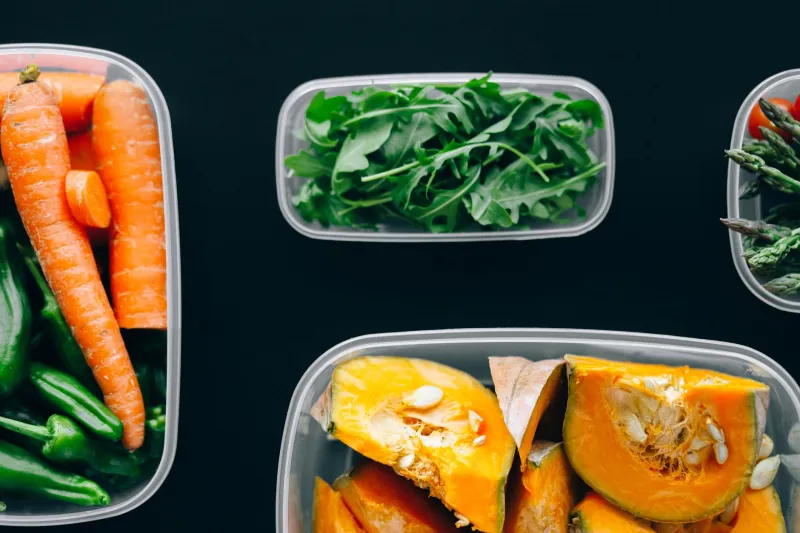
The flatlay — that overhead photograph of twelve identical containers arranged on a pristine surface, each one holding a geometrically precise portion of protein, complex carbohydrate, and aggressively green vegetable — is the entire point of the exercise. Not the eating. Not the nutrition. The photograph. The photograph that says: I am a person who has their Sunday under control, and by extension, their life, and by further extension, their mortality.
The influencer-industrial complex understood this early. The meal prep genre is not a cooking genre. It is an organizational aspiration genre, monetized through container affiliate links, macro-tracking app partnerships, and the quiet implication that if your Sundays look like this, you will be the kind of person who is never caught off guard by Tuesday.
Derek, 28, a graphic designer from Austin, spent eleven consecutive Sundays photographing his meal prep before eating any of it. 'I had a ring light specifically for the containers,' he told us. 'I tried seventeen different arrangements before I found the one that looked most like the videos. I got 340 likes on the best one. Then I ate the same chicken and broccoli for five days and wanted to actually die.'
The Standardization of Joy
There is a specific psychological event that occurs somewhere around the fourth or fifth week of committed meal prep practice. Researchers have not named it yet, so we will: it is the Quinoa Realization.
The Quinoa Realization arrives on a Wednesday, typically around noon, when you open your identical container for the fourth time that week and confront the food inside with an emotion that is not hunger. It is not satisfaction. It is something closer to the feeling you get looking at a spreadsheet — recognition without pleasure, competence without joy.
You made this. It is nutritionally correct. The macros are logged. The containers match. Everything is exactly as the video promised it would be. And you would give a meaningful percentage of your checking account to eat literally anything else, including the sad desk salad from the mediocre chain restaurant downstairs that you used to complain about before you became this version of yourself.
Marcus, 34, a financial analyst from Chicago, describes his Quinoa Realization with archaeological specificity. 'It was week six. Turkey meatballs, roasted sweet potato, steamed broccolini. I had made this exact meal six Sundays in a row. I sat down at my desk, opened the container, and I just... stared at it. I wasn't sad, exactly. I was something worse than sad. I was efficient.'
The Sunday Problem
Let us discuss what meal prep actually costs, in units that do not appear on grocery receipts.
A committed meal prep session consumes, on average, three to five hours of a Sunday. The Sunday is, by most cultural and anthropological measures, the last remaining unstructured time in the American adult calendar — the day that is not yet Monday, the day that theoretically contains the possibility of spontaneity, leisure, and the kind of unplanned afternoon that produces actual memories.
Meal prep colonizes this day. It converts it from possibility into production. You are not resting. You are not reading. You are not calling the friend you've been meaning to call since September. You are chopping. You are portioning. You are running the same sheet pan of vegetables through the same 400-degree oven for the third time and listening to a podcast about productivity, which is, when you say it out loud, a sentence that should concern you.
Amanda, 29, a teacher from Denver, quit meal prep on her fourteenth Sunday after a specific incident involving a mandoline slicer and an existential crisis. 'I cut my finger. Not badly. But I stood there for a second with a paper towel on my hand, looking at fourteen identical containers waiting to be filled, and I thought: is this what I'm doing with my one wild and precious life? And then I ordered a pizza and watched six hours of reality television and it was the best Sunday I'd had in three months.'
The Influencer's Cropping Technique
The most important thing to understand about meal prep content is what exists just outside the frame.
Just outside the frame: the three failed batches of grain that went mushy. The container that cracked in the dishwasher and had to be replaced at $8 apiece. The 45 minutes spent watching YouTube tutorials on how to properly cook farro, a grain you have now purchased twice and eaten zero times. The moment, somewhere around hour four, when you realize you haven't spoken to another human being all day and the only sounds in your apartment are the oven fan and the ambient noise of your own thoughts, which have turned, gradually, toward questions about your choices.
Also outside the frame: the eating. The content never shows the eating. The eating is the least photographable part of the process because the eating is just a person, alone, consuming a meal they made for themselves in a container that matches eleven other containers, on a Tuesday, at their desk, in the middle of an ordinary week that looks exactly like last week and will look exactly like next week, because that is what efficiency produces: perfect, beautiful, indistinguishable sameness.
The Deprogramming
We are not here to tell you meal prep is worthless. For some people, in some life configurations, batch cooking is a genuinely useful tool. We are here to tell you that the version being sold to you on social media — the glowing containers, the color-coded labels, the transformation narrative — is a product, and the product is not the food.
The product is the feeling of control. And control, as anyone who has spent fourteen Sundays portioning quinoa into identical vessels can tell you, is an excellent thing to sell to people who are anxious about the future, because the demand is infinite and the supply is always, always just slightly out of reach.
Kristin, for her part, still has the containers. She uses them for leftovers now — actual leftovers, from meals she cooked because she was hungry and wanted to eat something specific, not because a video told her who she could become if she just got organized enough on Sundays.
'I made pasta last week,' she said. 'Just pasta. No macros. No flatlay. I ate it on my couch and watched something stupid on TV and it tasted like the best thing I'd had in a year.'
She paused.
'It probably was.'