The Bottomless Pit: An Investigative Report Into the Great Mimosa Fraud and the Social Contract America Broke Over Brunch
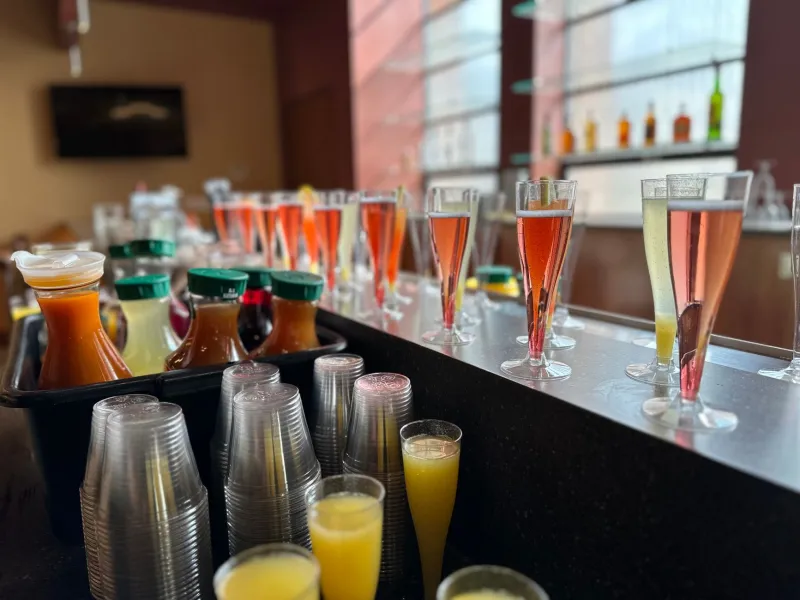
On a Saturday in late March, at a gastropub in Scottsdale, Arizona, that describes itself as 'a curated gathering space celebrating the intersection of intention and flavor,' a woman named Renata ordered the Bottomless Brunch Package.
She received one mimosa.
What followed was 90 minutes of escalating diplomatic failure — a standoff between one customer's reasonable interpretation of the word 'bottomless' and an establishment's creative reinterpretation of the same word as 'however many times our server, Chad, feels motivated to revisit your table, which, given current staffing levels and Chad's relationship with urgency, may be functionally zero.'
Renata did not receive a second mimosa. She did receive a $38 charge, a comment card, and the quiet, radicalizing conviction that something in America has gone deeply, structurally wrong.
She is not alone. This is her story. This is everyone's story. This is a brunch story.
Defining 'Bottomless': A Legal and Philosophical Crisis
The word 'bottomless' entered the American brunch vocabulary sometime in the late 1990s, when restaurants discovered that the promise of unlimited cheap sparkling wine drove table turnover, justified inflated prix fixe pricing, and created an atmosphere of festive abundance that photographed extremely well for what would eventually become Instagram.
At the time, the social contract was clear: you pay a fixed price, you drink however much you want within the allotted time window, the restaurant makes its money on the food and the volume, everyone goes home slightly pink-faced and satisfied. A deal, cleanly executed.
That contract is now deceased. In its place is a document so riddled with asterisks, fine print, and operational loopholes that constitutional lawyers have described it — when asked, hypothetically, over their own brunches — as 'genuinely impressive in its ambiguity.'
The modern bottomless mimosa package typically includes: one initial pour upon seating; a second pour if you make sustained eye contact with your server during a window of approximately 90 seconds when they pass within eight feet of your table; a third pour that requires the specific verbal invocation 'excuse me, could we get a refill?' delivered at a volume that acknowledges but does not inconvenience other diners; and all subsequent pours at the discretion of management, which is to say, never.
The Chad Variable
Central to understanding the bottomless mimosa collapse is the figure of Chad — not a specific person, but a composite archetype of the under-trained, over-sectioned, chronically distracted server who has been assigned responsibility for a six-table section during peak brunch hours and is, at any given moment, simultaneously processing a modified eggs Benedict order, a table's complaint about avocado ripeness, and a text from his roommate about the electric bill.
Chad is not malicious. Chad is structurally overwhelmed. The restaurant has calculated, correctly, that Chad's inability to maintain consistent refill cadence is more profitable than actually staffing the floor to deliver on the bottomless promise. Chad is the mechanism by which a contractual obligation is quietly converted into a suggestion.
The industry term for this is 'service pacing.' The customer term is 'fraud.' The gap between these two definitions is where brunch lives.
The Fine Print Nobody Reads (Because It Is Printed on the Placemat in Gray Ink on a Gray Background)
This publication obtained the actual terms and conditions governing bottomless brunch packages at eleven establishments across five states. The findings are, to use a technical term, illuminating.
One Phoenix restaurant defines 'bottomless' as 'unlimited refills subject to reasonable consumption and service availability.' 'Service availability,' the document clarifies in a footnote, 'is determined at the sole discretion of the serving staff and management.'
A Nashville establishment specifies that bottomless service 'applies to our house sparkling wine blend only, excludes holidays, special events, and periods of high volume, and is intended to complement your dining experience rather than constitute the primary focus thereof.' The primary focus, presumably, is the $24 chicken and waffle entrée that arrived lukewarm.
A Brooklyn brunch spot — and this is the one that should be taught in law schools — defines 'bottomless' parenthetically as '(while supplies last).' Supplies, it turns out, last approximately 45 minutes into a four-hour brunch service.
Renata's Testimony
We spoke with Renata at length. Her account has been edited for clarity, though not for temperature, which remains scalding.
'I flagged Chad four times,' she told us. 'Four. I made eye contact. I held up my empty glass. I used the words 'excuse me.' He said 'absolutely' twice and 'for sure' once and then disappeared into the kitchen and did not return for seventeen minutes, at which point he brought the wrong order to the table next to us and seemed genuinely surprised to see me still sitting there with my empty glass.'
Renata eventually spoke to a manager, a composed individual named Dax who explained that the restaurant was 'experiencing higher than anticipated volume' and that the bottomless package was 'always intended to be a value-add rather than a consumption guarantee.' Dax offered her a complimentary house-made granola bar. She declined. She left a Yelp review that is, by any measure, a masterwork of controlled fury.
'Three stars,' she told us. 'I gave them three stars. I'm not a monster.'
The $38 Question
Let us be precise about what $38 purchases at a contemporary American brunch establishment. It purchases: one glass of orange juice blended with a sparkling wine of regional provenance and aggressive mediocrity; the ambient experience of sitting near other people who also paid $38; the spiritual comfort of believing, for approximately the first twelve minutes, that you are participating in a civilized Saturday ritual; and a single line item on your credit card statement that, when reviewed Monday morning, will prompt a moment of quiet, unsmiling self-examination.
What it does not purchase: the bottom of the bottle. The refill that comes without asking. The second glass that arrives before the first one has fully warmed to room temperature. The thing that was advertised.
A Nation at the Crossroads
We are not, to be clear, calling for the abolition of brunch. Brunch is load-bearing infrastructure in the American social architecture. We are calling for honesty — the simple, radical act of menus that say what they mean.
'Occasional Mimosas, Depending on Chad's Bandwidth' is a less glamorous menu item than 'Bottomless Brunch Package.' It is, however, a true one. And in a country that has watched the word 'bottomless' become as legally meaningful as the word 'natural' on a cereal box, truth in advertising feels, at minimum, like a reasonable place to start.
Renata is still waiting for her refill. We all are.