Confessions of a Tip Screen Survivor: How Buying a Scone Became the Moral Trial of My Adult Life
An investigative report from The Food Woke Report, filed from a coffee shop where the tip screen is currently staring at me and I am not making eye contact.
I want to tell you about the morning I almost didn't buy a muffin.
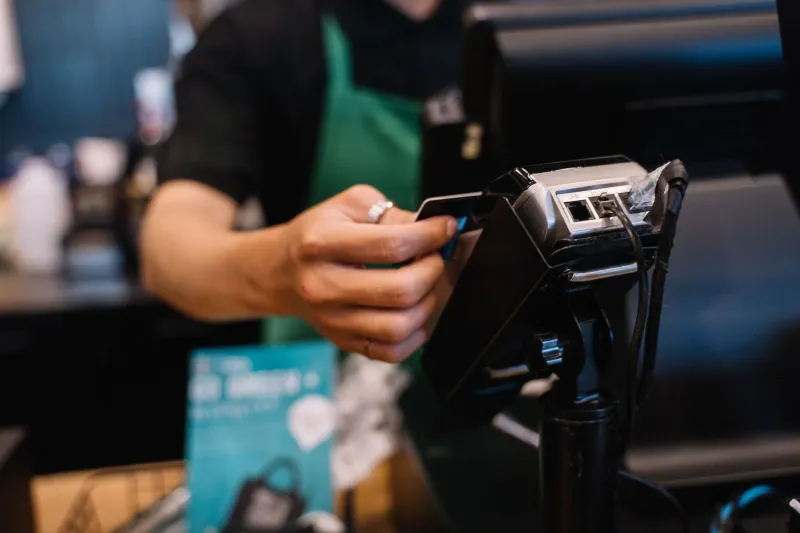
Not because I wasn't hungry. Not because the muffin was overpriced, though at $5.75 for a blueberry muffin in a paper bag handed to me across a counter by a person who had already turned away before I finished completing my transaction, "overpriced" feels like an understatement. I almost didn't buy the muffin because I could see the tip screen from the line, and I was not emotionally prepared.
The screen was offering me three options: 18%, 20%, and 25%. There was a fourth button, smaller, lower, positioned in the corner with the quiet shame of a child sent to stand in the hall. It said "Custom Amount." It did not say "No Tip." Pressing "No Tip" required navigating through "Custom Amount," entering a zero, and then confirming the zero, as if the software needed to hear me say it twice before it would believe I was really doing this.
I bought the muffin. I tipped 18%. The muffin was fine. I have not fully recovered.
A Brief History of Tip Creep
The tipping screen — technically a point-of-sale interface feature, colloquially known as "the moment" — began its life in sit-down restaurants, where it performed a reasonable function. You had a meal. Someone brought it to you, refilled your water, navigated your dietary restrictions with professional grace, and managed your table's increasingly chaotic group dynamic for ninety minutes. Tipping that person made sense. It still makes sense. This is not an article about tipping servers.
This is an article about what happened after.
Sometime around 2015, the tip screen began its territorial expansion. It moved into coffee shops first — reasonable enough, given that baristas are skilled workers who make your $6 latte with more technical precision than most people bring to their actual jobs. From there, it spread to fast-casual counters, where you ordered at a register and food was brought to a number on your table. Still arguable. Still within the realm of human interaction that might reasonably warrant acknowledgment.
And then it kept going.
The Current Frontier
As of this reporting, the tip screen has been confirmed at the following locations, which The Food Woke Report presents without editorial comment, because the editorial comment is implied:
Self-serve frozen yogurt kiosks, where you dispense your own product, weigh it yourself, and carry it to your own table. The screen asked for 20%. The machine did not thank you.
Airport grab-and-go coolers operated by automated checkout technology, where a camera watches you select your $14 sandwich and a screen processes your payment with no human involvement at any stage. The screen still asked. The camera watched you decide.
A food truck at a music festival in Austin where the line was 45 minutes long, the tacos were handed to you in a basket, and the tip screen defaulted to 25% with the other options requiring you to scroll. In 95-degree heat. While holding a beer.
A vending machine — and here The Food Woke Report must pause and acknowledge that this claim, reported by a source in Tempe, Arizona who wishes to remain anonymous for reasons that are entirely understandable, has not been independently verified. Our source insists, however, that the machine offered 15%, 18%, or 20% before releasing a bag of Fritos. We are choosing to believe them. It feels true in a way that matters.
 Photo: Tempe, Arizona, via i.pinimg.com
The Psychology of the Pause
What makes the tip screen genuinely remarkable as a piece of behavioral engineering is the pause it creates — a microsecond of social exposure in which your choice is visible, or feels visible, to everyone within eyeline. The barista has turned to make your drink. The person behind you in line is close enough that you can hear them breathing. The screen is bright. Your finger is hovering.
This pause is not accidental. Point-of-sale software companies — a sector that has somehow become one of the more morally complex industries in American commerce — have spent considerable resources optimizing the guilt window. The default amounts are set high. The "no tip" option requires extra steps. The screen orientation is frequently angled so that the person who served you can see what you're selecting, even when they're pretending not to look.
Consumers know this. Consumers resent this. Consumers tip anyway, at a rate that has increased every year since 2020, according to payment processing data. The machine is winning.
Who Is Actually Responsible for This
The honest answer, which the industry would prefer to deliver as a press release rather than a confession, is that tip screen inflation is a symptom of a labor cost crisis that restaurants and food service businesses have chosen to resolve by passing the discomfort directly to customers at the moment of maximum social vulnerability.
This is not a criticism of workers, who deserve to be paid fairly and who are not responsible for the psychological architecture of the payment terminal. This is a criticism of the system that decided the most elegant solution to fair compensation was a 4.3-inch touchscreen designed to make saying "no" feel like a moral failing.
The scone does not know any of this. The scone is just sitting there in its paper bag, waiting.
A Modest Proposal
The Food Woke Report does not have a policy position on tipping. We are a food satire website. Our policy positions are limited to the belief that the amuse-bouche deserved better and that protein bars have too many feelings.
What we do have is a suggestion: if we are going to install tip screens everywhere — at the kiosk, at the cooler, at the vending machine in Tempe — then we should at least make them honest. Skip the 18/20/25 theater. Just put one button on the screen that says what it actually means.
"Are you a good person?"
Because that's what it's asking. And we'd all feel a lot better if we could just answer it directly and get our muffin.