Part of This Complete Breakfast: How Cereal Companies Legally Convinced America That Candy Is a Morning Grain
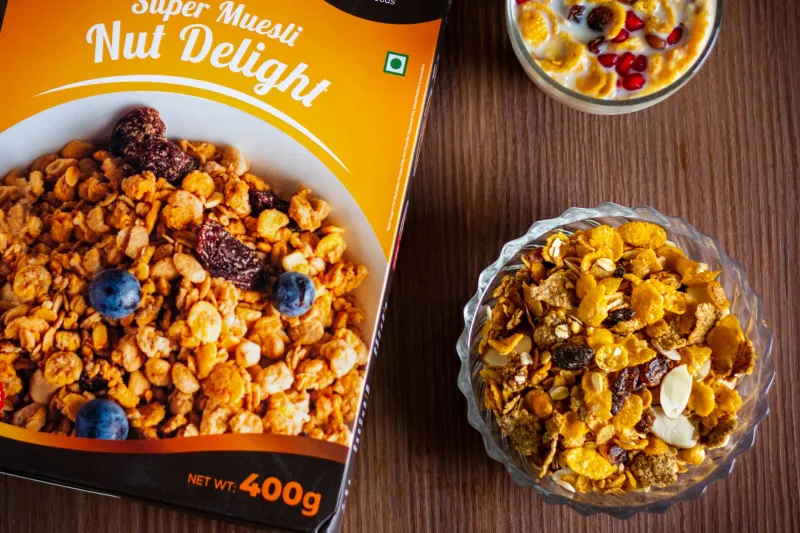
The photograph on the front of the cereal box shows a bowl of the product — let's call it what it is, which is pastel-colored sugar rings — surrounded by a glass of orange juice, a glass of milk, two slices of toast, a banana, and what appears to be a small bowl of strawberries. The complete breakfast, as depicted, contains approximately 800 calories and would take a motivated adult twelve minutes to prepare. The cereal itself contributes roughly 150 of those calories, 30 of which are from twelve grams of sugar, which is three teaspoons, which is the amount of sugar in three Oreos.
The box says this is part of a complete breakfast. The box is, technically, not lying. This is the most impressive legal achievement in American food marketing history, and it happened before most of us were born.
This is the story of how breakfast cereal became the longest-running nutritional magic trick in the United States — and how the trick still works on parents who absolutely know better, standing in the cereal aisle at 8:47 on a Tuesday morning, calculating whether the presence of 'whole grain' in the fourth ingredient slot is enough moral cover to buy the box with the cartoon dragon on it.
A Brief History of Breakfast as Battlefield
The modern American breakfast cereal was not invented for children. It was invented for sanitarium patients. John Harvey Kellogg developed his original grain flakes in the late 1890s as a digestive health intervention for the residents of his Battle Creek, Michigan health resort, where the dietary philosophy included extreme fiber intake and the complete elimination of meat and, ideally, most forms of pleasure.
This context is important because it explains the foundational tension in cereal marketing that has never fully resolved: the product began its life as a health food, got immediately hijacked by commerce, and has spent the subsequent 130 years trying to hold both identities simultaneously. It is health food. It is also a cartoon. It has riboflavin. It is also 38% sugar by weight. These things are all true at once and the industry has been very comfortable with that.
By the 1950s, television advertising had introduced cereal to children as a direct demographic, bypassing parents entirely and establishing the first great breakfast negotiation dynamic that still plays out in American kitchens every morning. The cartoon mascot — Tony the Tiger, Toucan Sam, Cap'n Crunch, the Trix rabbit — was not selling to the person buying the groceries. It was selling to the person screaming in the cart, creating demand that the parent then had to either satisfy or spend fifteen minutes explaining, which, at 7 a.m. on a school day, is not a fight most people have the bandwidth to win.
The 'Complete Breakfast' Gambit: A Legal Deep Dive
In 1969, the Federal Trade Commission held hearings on television advertising to children. One outcome was the 'complete breakfast' disclaimer — the on-screen depiction of cereal accompanied by a full supporting cast of nutritionally legitimate foods — which was designed to contextualize the cereal within a balanced meal rather than present it as sufficient nutrition on its own.
Read that again slowly. The solution to the problem of marketing nutritionally questionable food to children was to show the food next to better food and call the combination a meal.
The cereal does not have to be nutritious. The breakfast has to be complete. The cereal just has to be part of it. 'Part of' is doing the work of an entire regulatory framework in two words, and it has been doing that work, unchallenged, for over fifty years.
This is the equivalent of a cigarette company running an ad that shows a person smoking while also jogging, drinking green juice, and getting adequate sleep, with the tagline: 'Part of an active lifestyle.' It is absurd. It is also, within the specific logic of food marketing law, airtight.
The Whole Grain Gambit, the Vitamin Gambit, and the Fiber Gambit
Over the decades, as nutritional science became more publicly legible and parents became more label-literate, the industry developed a suite of supplementary claims to run alongside the complete breakfast defense.
The Whole Grain Gambit emerged in the late 1990s and early 2000s as whole grain consumption became associated with reduced disease risk. The FDA allows a product to carry a 'whole grain' claim if whole grain is the first ingredient by weight. What this means in practice is that a cereal can be 'made with whole grain' and still contain 39 grams of sugar per serving, because the whole grain claim is about ingredient order, not nutritional profile. The whole grain is there. It is just accompanied by enough sugar to qualify as a dessert in eleven countries.
The Vitamin Gambit is arguably the most elegant. Beginning in the mid-20th century, manufacturers began fortifying cereals with synthetic vitamins and then advertising those vitamins as evidence of nutritional value. The cereal does not contain these vitamins naturally. They are added during manufacturing, the same way vitamins are added to gummy bears, energy drinks, and novelty water. 'A good source of Vitamin D' on a cereal box means a chemist added Vitamin D to the cereal at the factory. It does not mean the cereal is nutritious. It means the cereal has been improved from the baseline of 'sugar and air' to 'sugar and air, plus some B12.'
The Fiber Gambit is the newest and perhaps most brazen. Several major cereal brands have in recent years added isolated fiber — chicory root extract, inulin, soluble corn fiber — to otherwise sugar-dense products and then prominently advertised the fiber content. This is nutritionally legitimate in the narrowest sense and practically meaningless in the broader one. Isolated fiber added to a processed food does not confer the same health benefits as fiber consumed in whole food form. The science on this is not settled, which is the exact level of scientific unsettlement the food industry prefers.
The Parent in the Aisle: A Portrait
At approximately 9 a.m. on any given Saturday, in any given American grocery store, a parent stands in the cereal aisle and performs a ritual so practiced it has become unconscious. They pick up the box with the cartoon on it — the one their child has been requesting since seeing the commercial during whatever streaming content has replaced Saturday morning cartoons — and they flip it over.
They look at the sugar content. They note that it is high. They look at the whole grain claim. They note that it exists. They look at the vitamin panel. They note the presence of iron, which they vaguely recall being important. They look at the serving size, which is three-quarters of a cup, which is not a real amount of cereal that any human has ever poured into a bowl. They look at the price, which is $5.49, which is lower than the $6.99 box of the cereal they actually want to buy, which is the one with less sugar but no cartoon and no whole grain claim and, honestly, doesn't taste as good.
They put the cartoon cereal in the cart. They feel a specific flavor of defeat that has no name but is familiar to every parent in America. They move on to the yogurt aisle, where this exact situation will repeat itself.
The Verdict
The cereal companies have not lied to you. They have done something more sophisticated than lying: they have constructed a nutritional narrative so thoroughly scaffolded by technically accurate claims that the truth is always technically present and always practically obscured.
The freeze-dried strawberry pieces are real fruit. There are just four of them per serving and they have been processed into something with the structural integrity of a styrofoam packing peanut. The whole grain is real. It is just accompanied by enough high-fructose corn syrup to constitute a separate food group. The vitamins are real. A factory put them there on purpose.
Part of a complete breakfast. Part of. Two words that have done more work for the American processed food industry than any regulatory framework has ever undone.
Tony the Tiger has been telling you it's great for 70 years. He is not wrong about everything. He is just not your doctor. And he is not, it turns out, required to be.