The Spin: Inside the 30-Second Moral Collapse That Happens Every Time a Tablet Rotates in Your Direction
Photo: Ross Dunn, CC BY-SA 2.0, via Wikimedia Commons
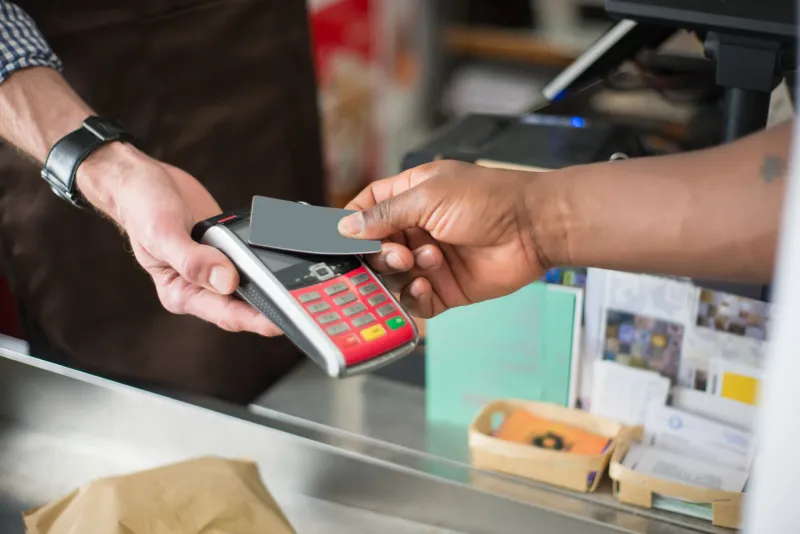
I want to be a good person. I think about this often, especially in the thirty seconds after a Square terminal has been rotated in my direction at a counter where I have just watched an employee press a single button to heat my sandwich in a machine that does not require skill, creativity, or, arguably, consciousness.
The screen glows. The options appear. Fifteen percent. Twenty percent. Twenty-five percent. Thirty percent. And then, at the bottom, in a font that somehow communicates both neutrality and judgment: Custom Amount.
A small part of me dies every time.
The Architecture of Guilt
Let's start with the design, because the design is doing a lot of work here and it deserves credit.
The modern tip screen is a masterpiece of behavioral engineering. It is not asking you to tip. It is assuming you will tip and asking only how generously. The lowest option — in many establishments now a floor of 18% that would have been considered generous in a full-service restaurant eight years ago — is positioned not as the minimum but as the implied statement of a person who is, perhaps, going through something difficult. The 25% option glows with quiet righteousness. The 30% option is there to make 25% feel reasonable.
The "No Tip" or "Custom" button, meanwhile, is styled in a way that communicates exactly what the designer intended: you can press this, but we want you to know that we know. It is smaller. It is grayer. It is the button equivalent of a disappointed sigh.
This is not an accident. This is a choice made in a conference room by people who understood that shame is a more reliable motivator than gratitude.
A Brief Taxonomy of Tipping Locations That Have No Business Having a Tip Screen
I need to document what I have witnessed personally, because I am concerned that if I don't write it down, future generations will not believe us.
I have been presented with a tip prompt at a self-checkout kiosk where I scanned my own items, bagged my own groceries, and troubleshot my own "unexpected item in bagging area" error without assistance from any human being. The screen asked if I wanted to leave a tip. I stood there for a moment. I pressed Custom and typed zero. I have not fully recovered.
I have been offered a tip screen at a bakery counter where the transaction consisted of a person placing a pre-made muffin into a paper bag. The muffin was already in the case. The bag was already open. The journey from case to bag took approximately two seconds. The tip screen appeared. The suggested amount was $1.50.
I will not name the Baltimore parking garage. I will say only that it exists, that it has a tip prompt on its automated payment kiosk, and that the kiosk is a machine. There is no person. The machine is requesting a tip for the service of accepting my credit card and raising a gate. I pressed No Tip and drove away at speed.
The Thirty-Second Moral Negotiation
Here is what actually happens in the thirty seconds between the screen spin and the button press, rendered in real time:
Second 1-3: You register the options. Your brain performs an automatic calculation that you did not ask it to perform.
Second 4-7: You consider the worker. You think about what they're paid. You think about the economy. You think about a piece you read in the Times about tip culture and whether tipping is actually good for workers or whether it just allows employers to pay below minimum wage and shift the moral burden onto customers. You do not remember the conclusion of the piece.
Second 8-12: You become aware of the person behind you in line. You cannot see their face. You can feel their presence. You imagine what they think of you. You wonder if they can see the screen. They can probably see the screen.
Second 13-18: You hover over 20%. You wonder if 20% is enough. You wonder if "enough" is even the right framework. You wonder when you agreed to this framework. You do not remember agreeing to this framework.
Second 19-24: You think about the last time you were genuinely, enthusiastically tipped in your own job and you realize this has never happened to you and you feel a complicated feeling about that.
Second 25-28: You press a button. You're not entirely sure which one. Your hand moved on its own.
Second 29-30: The receipt prints. You take it without looking at it. You will look at it later, alone.
The Gaslighting, Specifically
What I want to name — clearly, on the record, in a food satire publication — is the gaslighting.
We have been gradually, systematically convinced that declining to tip at a counter-service establishment is a moral failing equivalent to, at minimum, cutting in line at a funeral. The social machinery around tip culture has been engineered so precisely that a reasonable adult can feel genuine shame about not leaving 25% at a place where they waited in line, placed their own order, carried their own food to a table, and bused their own tray.
This is a remarkable achievement. The restaurant industry, facing genuine structural labor cost problems, has successfully outsourced the entire moral weight of those problems onto the customer's nervous system, at the point of sale, in thirty seconds, with a rotating iPad.
I'm not saying don't tip. I'm saying: notice what's happening. Notice the spin. Notice the button sizing. Notice the way "No Tip" has been made to feel like a confession.
What I Actually Do
I tip. I tip at coffee shops and sandwich counters and bakeries. I tip inconsistently and probably irrationally, based on a combination of factors that I could not fully articulate if asked, which I won't be, because no one is asking.
I do not tip the parking garage kiosk. I have drawn a line there. The line is: if there is no human being involved in the transaction, I am not tipping the transaction. I feel this is reasonable. I feel this every morning when I make my own coffee and do not Venmo myself fifteen percent.
The screen will keep spinning. The options will keep climbing. Somewhere, in a conference room, someone is debating whether 35% should be the new suggested floor, and whether the No Tip button should be removed entirely for a period of "testing."
They will test it. We will adapt. The muffin will still be pre-made.
The Food Woke Report tips on service, not on spin. We cannot speak for the parking garage.