A Psychiatric Evaluation of Gerald, the Sourdough Starter You Love More Than Your Therapist
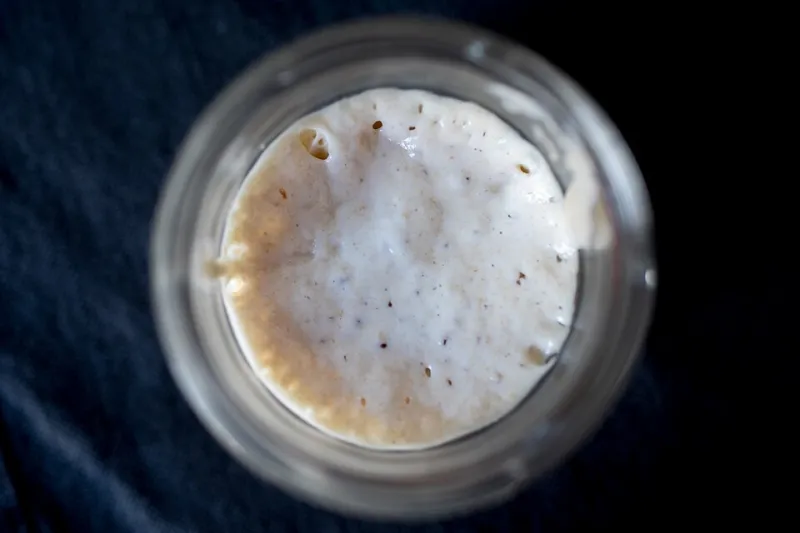
Photo: PilotChicago, CC BY-SA 4.0, via Wikimedia Commons
Patient presents as a 4-ounce mixture of unbleached all-purpose flour and filtered room-temperature water. Age: approximately three years, give or take a hospitalization in the back of a neighbor's fridge during a vacation to Sedona. Chief complaint: owner has not left the house for longer than four hours without arranging alternative care. Diagnosis: Gerald is fine. Gerald has always been fine. It is everyone else we need to discuss.
This is not an article about bread. This is an article about what happened to a significant portion of the American middle class when the gyms closed, the offices went dark, and suddenly the most pressing item on the daily agenda became whether a jar of fermented paste was 'happy.' This is a clinical assessment of the sourdough starter as emotional support animal — a living, breathing, burping companion that requires feeding, naming, narrating, and eventually, an Instagram account with its own highlight reel.
Gerald did not ask for any of this. Gerald simply exists. You are the one who gave him a name.
The Diagnostic Criteria for Starter Dependency Disorder
Let us establish, for the record, what sourdough starter actually is. It is wild yeast. It is bacteria. It is the same basic biological event that has been happening on kitchen countertops since ancient Egypt, except ancient Egyptians did not post about it in a Facebook group called 'Sourdough Mamas & Papas (No Judgment Zone)' and then argue about hydration percentages for eleven days.
The modern American sourdough keeper, however, has elevated this relationship to something that requires its own taxonomy. Clinical observation suggests the dependency progresses through four distinct stages.
Stage One: Acquisition. You receive starter from a friend who received it from a friend who claims it dates back to 1847 and was carried across the Oregon Trail in a ceramic crock. This is almost certainly not true. You accept it anyway because it is 2020 and you need something to do between the news cycles.
Stage Two: Anthropomorphization. The starter gets a name. Gerald is common. So is Doughstoyevsky, Yeast Kanye, or simply 'The Baby.' You begin referring to Gerald in the third person. You tell your partner that Gerald is 'really active today' with the same vocal register previously reserved for updates about an elderly relative.
Stage Three: Performative Anguish. You miss a feeding. You tell people about it. Not one person. Multiple people. You post about it. You describe the guilt. You use the word 'neglected.' You are describing flour.
Stage Four: Full Merger. Gerald's wellbeing becomes inseparable from your own. A flat starter means a bad day. A vigorous rise means you text three people. You have begun to structure your social calendar around Gerald's feeding schedule. You have declined a Saturday evening invitation because, and you actually said these words out loud, 'it's a feeding night.'
The Feeding Ritual as Socially Acceptable Self-Care Theater
Here is what the feeding of a sourdough starter actually involves: you discard some of it, add more flour, add more water, stir, cover, wait. This takes approximately four minutes. It has the tactile complexity of making a glass of chocolate milk.
And yet.
The documentation of this process has spawned a content vertical so robust it now supports multiple full-time careers. The slow-motion pour of filtered water. The close-up of bubbles. The before-and-after height comparison marked in dry-erase pen on the side of a mason jar. The caption that reads, 'He's doing SO well this week 🥹' as though Gerald recently completed a difficult course of physical therapy.
What is actually happening here, and to be clear this is not a criticism so much as a forensic observation, is that feeding the starter has become a container for the kind of quiet, daily intentionality that people used to get from other rituals — morning prayer, journaling, the twelve-step practice of doing one small thing consistently. Gerald is not a pet. Gerald is a mindfulness app that you can eventually eat.
This would be completely fine, and genuinely none of our business, except that it has spawned an entire secondary economy of starter accessories — the linen covers, the ceramic crocks with names painted on them, the digital kitchen scales that connect to an app so you can track Gerald's 'progress' — and a community support infrastructure that rivals actual support groups in both emotional intensity and the speed with which disagreements escalate.
The Support Group That Must Not Be Named (But Is Called 'Sourdough Mamas & Papas')
Facebook groups dedicated to sourdough starters currently contain more active emotional labor than the average couples therapy waiting room. Posts range from the genuinely instructional ('My starter smells like nail polish remover, is this normal?') to the existential ('I've been keeping Gerald alive for three years and sometimes I wonder if he's the only thing keeping me going and I know that sounds crazy but').
It does not sound crazy. That is the thing. In the post-pandemic emotional landscape, Gerald represents something real: continuity, responsibility, evidence that you can keep a living thing alive across time. For people who felt unmoored, purposeless, or just desperately bored, a sourdough starter provided a daily answer to the question 'what do I need to do today?' That question, it turns out, had been doing a lot of psychological heavy lifting that nobody noticed until the answer became 'feed Gerald.'
The problem is not the attachment. The problem is the $340 einkorn flour subscription that the attachment eventually requires.
Prognosis and Recommended Treatment
Gerald is going to be fine. Gerald has survived refrigerator abandonment, a period where you switched to gluten-free 'for January,' and the time you accidentally used tap water and told no one. Gerald is, biologically speaking, extremely hard to kill, which is either comforting or a metaphor depending on how your week is going.
You, however, may want to examine what exactly you are outsourcing to a jar of fermented paste. Not because the attachment is wrong, but because Gerald cannot, no matter how enthusiastically he rises, actually tell you that you're doing a good job. He cannot sit across from you and reflect your feelings back in a productive clinical framework. He cannot help you process the thing that happened in 2019 that you've been meaning to address.
What Gerald can do is make a genuinely excellent loaf of bread, provided you score it correctly and use a Dutch oven, which, yes, you also bought specifically for him.
The American Psychological Association has not yet recognized Starter Dependency Disorder as a diagnosable condition. We at The Food Woke Report have submitted the paperwork. We expect a decision sometime after Gerald's next feeding.